
Short answer first: not yet, and not for work like this. AI can now make a single image that looks very real, in seconds. What it still cannot do on its own is hold one exact design steady from every angle, at the right size, with every pattern lining up. That part needs a 3D model and the people who build it.
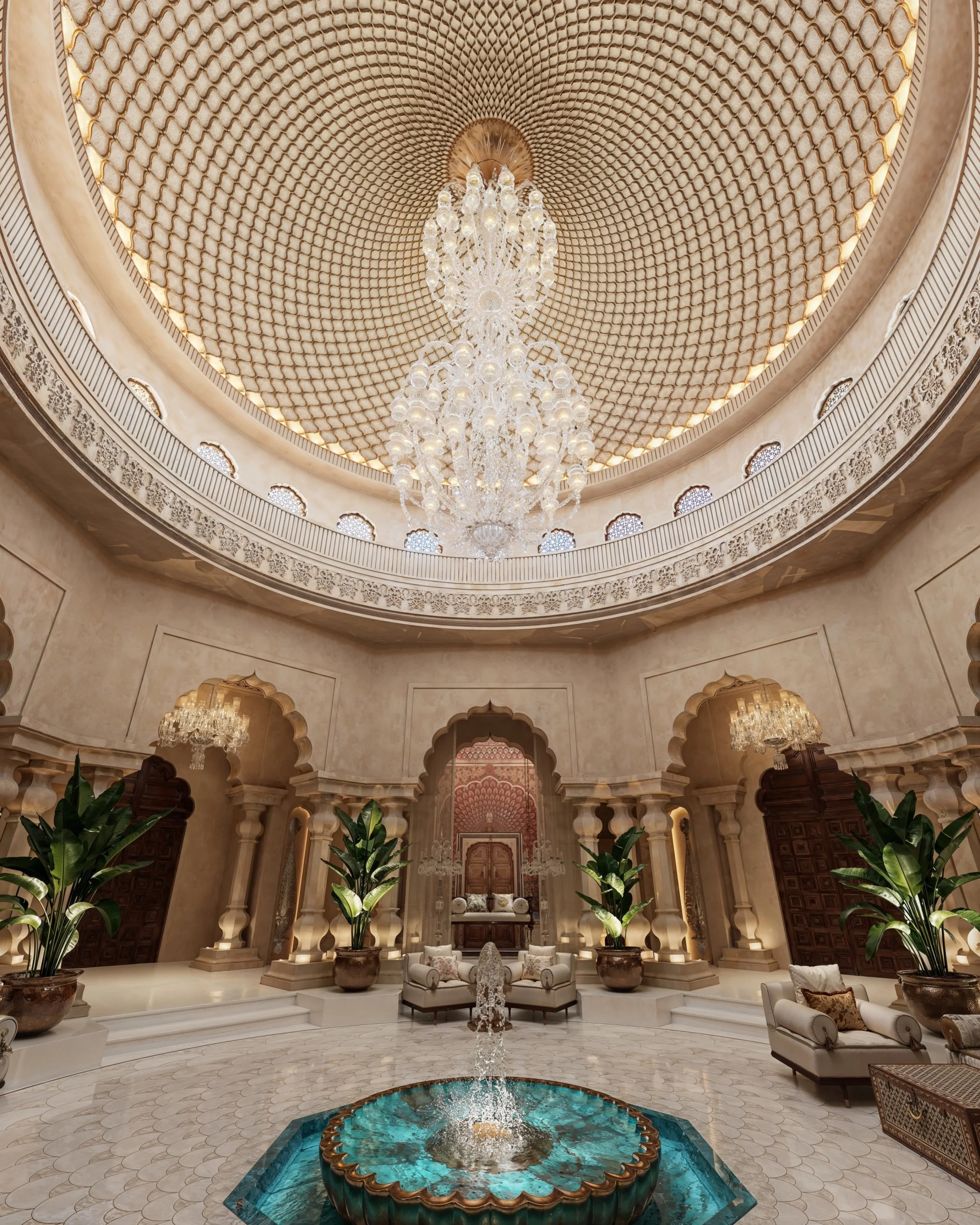
Here is a project that shows why. It is the atrium of a private palace in Saudi Arabia, designed by architect Vistasp Kharas of Vistaps Kharas Studios, and visualised by our studio. The palace is a private home, so we do not name the owner.
"We don't need 3D artists anymore"
You hear this line a lot right now. And honestly, AI today can make things look very real.
A chandelier about 40 feet tall? The materials look convincing. The lighting looks beautiful. For a first mood image in an early meeting, that can be enough.
But a mood image and a project are two different things.
The atrium
The space is round and tall. A dome with a gold lattice pattern sits on top, ringed by small arched windows. A crystal chandelier about 40 feet tall hangs from the centre. Below it, a turquoise fountain sits in a pale stone floor laid in a petal pattern. Around the edge, scalloped arches open into niches: seating areas, carved wooden doors, and a swing seat set against a pink lotus pattern.
Every one of those things has a real size, and every pattern has to meet the next one somewhere. That is where the trouble starts for AI.
Change the camera, and the design changes
Most AI image tools do not keep a 3D model of the space. Each picture is made fresh, from a written description or a reference image. Ask for a new angle and you do not get the same room from somewhere else. You get a new guess at the room.
So the problems show up the moment you move the camera. Proportions shift. Details drift. Geometry does not quite hold. Then the questions start:
- Will that chandelier stay the same size from every angle?
- Will the floor pattern line up under the arches and around the fountain?
- Will the dome look the same from below as it does from above?
- Will the light behave the same in stills, walkthroughs and VR?
- Will the design actually hold up when it is built?
For one image, nobody checks. For a palace, everyone does: the architect, the client, the contractor and the craftsmen who have to make it.
Why one 3D model solves it
In 3D, there is one model of the atrium, built to size. Every camera looks at that same model. The chandelier is about 40 feet tall in every view because it is one object, about 40 feet tall. The floor pattern lines up because it was laid once. Move the camera and only the view changes. The design does not.
That is where images stop being pictures and start being decisions. An architect can check a sightline. A client can see how the chandelier sits against the dome. A builder can count the petals in the floor. None of that works if the next image quietly changes the answer.
Where AI did help us
We used AI on this project. Absolutely. For speed, for exploring ideas and for references.
But turning it into something precise, consistent and buildable still needed hands, judgement and control.
That is also where AI tools for our industry are heading. The most useful ones now start from the 3D model instead of replacing it. Chaos, the company behind V-Ray and Corona, builds an AI tool called Veras into both renderers. It starts from a screenshot of the 3D scene, so it works from the real design instead of guessing it. AI works best on top of the model, not instead of it.
We wrote about how much time AI really saves a working studio in The 35% Myth. The short version: it saves real time, just far less than people claim online.
Will AI get better?
Yes. Much better.
But for this level of detail, it will still need creative hands shaping it. At this level, you are not just making it look real. You are making it work.
And that part is not automated yet.
If you are commissioning renders
A few simple checks, whether your studio uses AI or not:
- Ask if the images come from one 3D model. If they do, every view will agree with every other view.
- Ask to see the same space from more than one angle. It is the quickest test there is.
- Use AI images for early mood, by all means. Just do not sign off sizes, patterns or materials from them.
- Think about what comes next. If you will want a walkthrough or a 360 tour later, the 3D model is what makes that possible.
You can see more of our work on the work page, find plain definitions of these terms in our glossary, and if you have a project like this in mind, talk to us. If you are choosing software, our Blender vs 3ds Max vs Unreal piece looks at what each tool does best.